
New FMCSA Regulations: What Freight Brokers Need to Know
 On January 16, 2024, the Federal Motor Carrier Safety Administration (FMCSA) published a final rule overhauling the financial security requirements for freight brokers and freight forwarders. While parts of the rule take effect earlier, the stricter compliance provisions for BMC-85 trust fund filers will apply starting January 16, 2026, signaling a major shift in how broker financial responsibility is enforced.
If you currently use a BMC-85 trust fund, these changes may leave you out of compliance. You’ll need to act soon or risk a suspension of your operating authority.
Every active freight broker in the U.S. must maintain either a BMC-84 bond or a BMC-85 trust fund with the FMCSA. If you want to confirm your current filing, you can check by visiting the FMCSA Licensing and Insurance portal and searching your company by MC number, USDOT number, or name.
What’s Changing for Freight Brokers Using BMC-85 (effective Jan 16, 2026)
Here are the 5 key provisions of the new FMCSA rule:
1. Suspension for Non-Compliance Now Has Defined Triggers and a 7-Day Replenishment Period
Before: If your financial security fell below $75,000, FMCSA typically allowed 30 days to correct the issue, with less-defined triggers and no standard timeline.
What’s new: From 2026, FMCSA can suspend your authority if your available financial security drops below $75,000 due to a drawdown, ignored claim notice, or judgment. You have 7 calendar days from notice to replenish funds, though the 30-day period still applies in certain cancellation cases.
What you should do now:
- Monitor your security balance and address claim notices immediately
- Be ready to restore funds within 7 days to avoid suspension
- Ensure your provider can report compliance promptly via FMCSA’s URS
2. Stricter BMC-85 Asset Rules
Before: BMC-85 trust fund assets could include less liquid holdings, such as accounts receivable or personal loans, which could take weeks or months to convert to cash for paying claims.
What’s new: Trust fund assets must now be liquid within 7 calendar days and held only in:
- FDIC-insured irrevocable letters of credit
- Cash or cash equivalents
- U.S. Treasury securities
Non-liquid assets like accounts receivable or personal loans no longer qualify. This change is intended to ensure funds are quickly available to pay valid claims.
What you should do now:
- Review your trust fund’s asset composition
- Replace any non-qualifying assets with approved, 7-day liquid instruments before the January 16, 2026, deadline
3. New Requirements for BMC-85 Trustees
Before: Loan and finance companies, as well as other non-bank entities, could serve as BMC-85 trustees, often with minimal oversight.
What’s new: FMCSA has removed loan and finance companies from the list of eligible trustees. Going forward, only federally regulated financial institutions can serve, including:
- FDIC-insured banks
- Federally regulated trust companies
- NCUA-regulated credit unions
FMCSA estimates over 90% of current BMC-85 providers will no longer qualify, meaning many brokers will need a new trustee or a BMC-84 bond to remain compliant.
What you should do now:
- Check if your trustee meets the new federal eligibility standards
- If not, plan your switch before the January 16, 2026 compliance date
4. Enhanced FMCSA Oversight
Before: FMCSA’s ability to oversee trust funds and take enforcement action was more limited. Reporting of non-compliance by trustees or sureties was not always immediate, and FMCSA had less direct control over disbursements when a broker became insolvent.
What’s new: From 2026, FMCSA gains:
- Broader authority to freeze or revoke a broker’s operating authority
- The ability to require automatic reporting of non-compliance from trustees and sureties
- Direct control over how BMC-85 trust funds are disbursed in the event of broker insolvency
What you should do now:
- Maintain open communication with your trustee or surety to ensure they meet new reporting requirements
- Keep your FMCSA records and contact information current so you receive compliance notices promptly
- Address any non-compliance issues immediately to avoid enforcement actions
5. Potential Cost Increases for BMC-85 Trusts
Before: BMC-85 costs varied by provider, with some non-bank trustees keeping fees low by using less liquid or higher-risk assets and facing minimal oversight.
What’s new: From 2026, only federally regulated financial institutions (e.g., FDIC-insured banks, NCUA-regulated credit unions) can serve as trustees, and assets must be held entirely in cash, U.S. Treasury securities, or FDIC-insured irrevocable letters of credit. These stricter requirements are expected to raise trustee costs, which may be passed on to brokers.
What you should do now:
- Ask your trustee how the new rules will affect fees and service
- Compare potential costs with BMC-84 bond premiums
- Prepare for possible provider changes before January 16, 2026
Why the BMC-84 Bond Is Now the Best Option
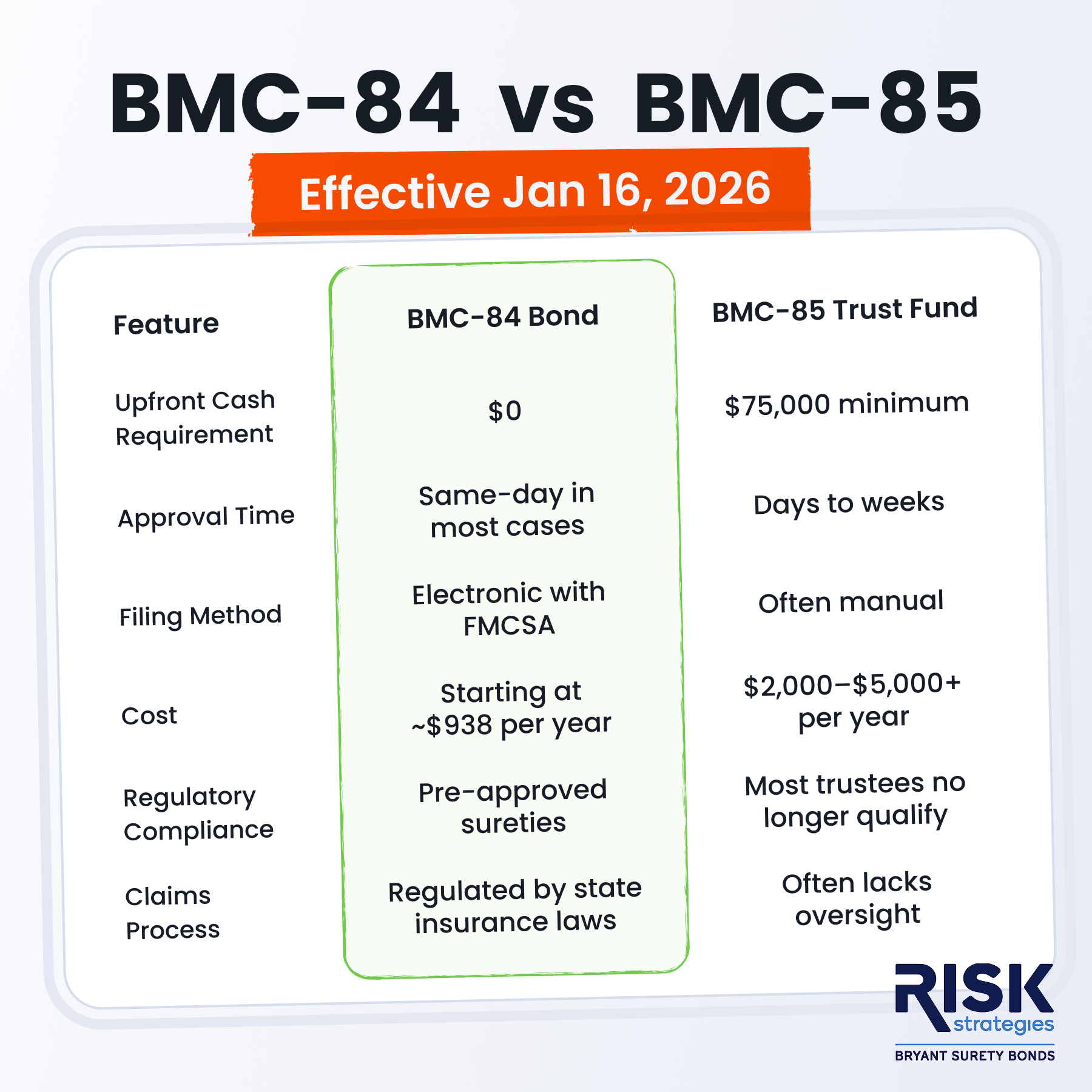
The BMC-84 surety bond has always been a popular alternative to the BMC-85 trust. With the 2026 FMCSA rule changes, it’s now the smartest and safest choice for most brokers. Here’s how they compare:
Why FMCSA Updated the Freight Broker Requirements
FMCSA’s 2026 rule changes stem from long-standing concerns over the lack of oversight and liquidity in many BMC-85 trust fund arrangements. A 2023 Government Accountability Office (GAO) report found that many trust providers used questionable or illiquid assets, such as personal loans and accounts receivable, that failed to protect carriers and shippers when brokers went out of business.
Some BMC-85 providers weren’t regulated banks or trust companies at all, and several collapsed under fraud investigations or insolvency, leaving unpaid claims and eroding industry trust. FMCSA stated the existing system posed a “significant risk to the financial integrity of the transportation sector.”
By tightening the rules, FMCSA aims to eliminate unreliable trust fund providers, reduce unpaid claims, and ensure that financial security filings actually serve their intended purpose: protecting motor carriers and consumers from broker non-payment.
Next Steps for Freight Brokers
If your BMC-85 provider isn’t FDIC-insured or can’t meet the new liquidity rules, you may not be able to renew your trust fund – putting your operating authority at risk. Here’s what to do:
- Review your current BMC-85 provider now – Confirm they’re FDIC-insured and meet the 2026 eligibility and asset requirements.
- Decide on your compliance path:
- Switch to a BMC-84 bond
- Or move to a compliant BMC-85 provider (availability will be limited)
- Complete the switch before Jan 16, 2026, or before your current BMC-85 trust expires if it ends sooner.
- Cancel your old trust once your new filing is active with FMCSA.
- Act early to avoid last-minute delays or gaps in compliance.
While FMCSA acknowledges some brokers may leave the market, the new standards aim to improve trust, reduce fraud, and strengthen protections for carriers.
Thinking of Switching to a BMC-84 Bond?
If your BMC-85 trust provider isn’t FDIC-insured or can’t meet FMCSA’s new liquidity and eligibility requirements, you’ll need to take action before your policy expires or the January 16, 2026 deadline. Switching to a BMC-84 surety bond is the safest, most widely available option, and you can see how much it will cost you in just a few minutes.
Apply for a same-day, no-obligation BMC-84 quote in 3 steps:
- Complete our short online application – takes less than 5 minutes.
- Receive your personalized quote from multiple top-rated insurance carriers.
- Activate your bond, and we’ll file it directly with the FMCSA.
Why choose Bryant Surety Bonds?
As part of Risk Strategies, we cover more than 42% of all BMC-84 bonds in the U.S. Our team has been trusted by freight brokers since 2013, writing more BMC-84 bonds than any other agency and working with multiple A-rated carriers to secure the best rates.
Get started today and protect your authority with confidence.
- Bio
- Latest Posts





Before i fill out an application i would like to see your contract.
Hi Phill,
Thanks for your comment.
If you’re referring to a “contract,” there isn’t a binding contract just to submit an application. The online application is simply an information step so we can understand your details and provide an accurate BMC-84 bond quote.
Once the application is submitted, one of our licensed agents will review it and contact you with the quote and terms. At that point, you can decide whether you want to move forward or ask any additional questions—there’s no obligation.
If you’d prefer to speak with someone before applying, you’re also welcome to call us directly at 866.450.3412 (Mon–Fri, 8:30AM–5:00PM EST) and we’ll be happy to walk you through the process.